

Trish Clark Gallery is very pleased to present Postscript, a solo exhibition by Sefton Rani, his first at the gallery and a significant moment in the ongoing development of one of Aotearoa’s most distinctive contemporary practices.
Awarded the prestigious McCahon House Parehuia artist residency in 2025, that supported period allowed Rani to undertake work of an ambition and scale not previously able to be countenanced. The magisterial work produced at the Residency, two by six metres of extraordinary physical presence that is simultaneously monument and material record, anchors this solo exhibition at Trish Clark Gallery. A curated selection of further works accompanies Gabrielle, together tracing the range and rigour of Rani’s evolving inquiry.
Rani states, Making gives me an opportunity to think. To think about heritage arts, think about my place in that lineage, how I feel the ancestors watching, how I strive to extend what Pacific art is.[It ] gives me a reason to research history … which is my way into understanding what it is to be an urban Polynesian as the information of the past was not handed down.
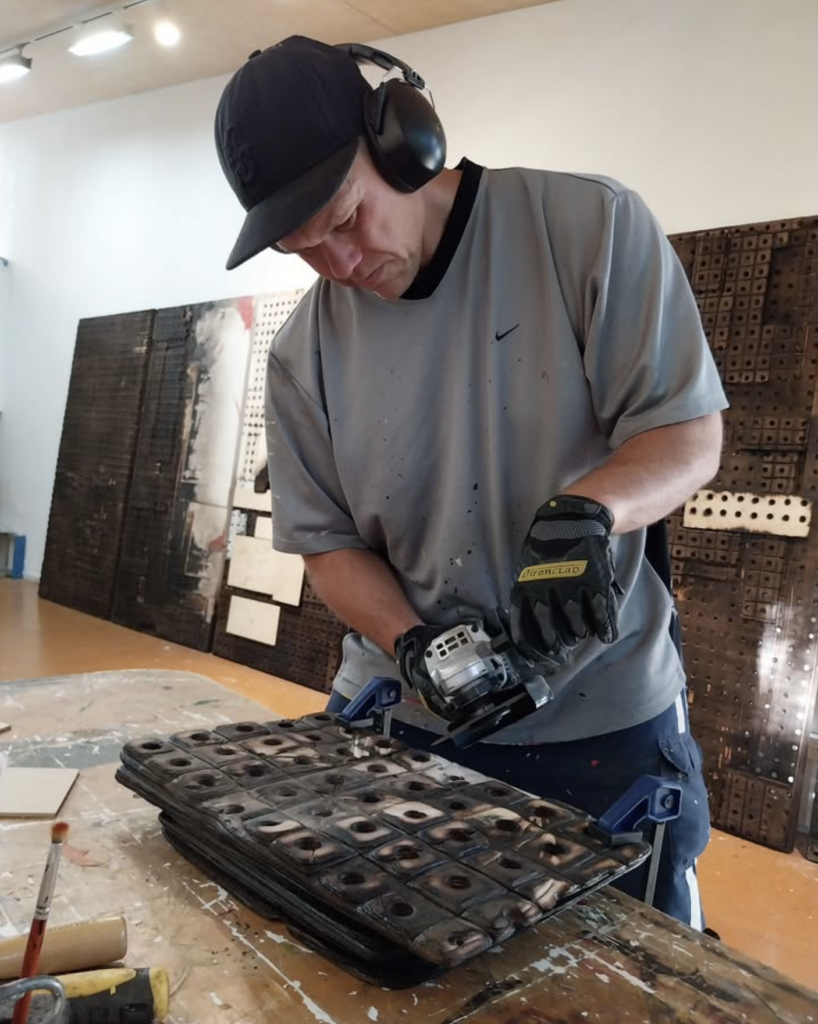
The multiple physical and narrative layers created in each work’s journey empowers him to interrogate his ‘Pacificness’ while addressing universal themes. Referring to his works as ‘industrial tapa’ and working with wood and paint as primary mediums and sculptural material, Rani constructs his works through a painstaking process of producing, layering and manipulating solidified paint skins — surfaces that blister, hold impressions, imitate industrial textures, and submit to blowtorch and blade. The process itself carries meaning: years spent working in an Auckland paint factory are not merely biographical backdrop but active material, embedded in the work’s very constitution. In this way each piece becomes both homage and argument — that labour is a material with value, and that the lives of those who perform it are worthy of the same sustained attention afforded to more visible cultural traditions.
The title Postscript is apt. Where a postscript supplements what has already been said — adding what was overlooked, deferred, or too important to omit — Rani’s practice consistently performs this act of recovery. Drawing on traditional tapa, carving, tattoo, weaving and tivaevae while refusing their reduction to motif or ornament, his work extends the lineage documented by Dr Karen Stevenson in The Frangipani is Dead: Contemporary Pacific Art in New Zealand, 1985–2000 (2008): art born of the Pasifika diaspora, navigating the precarious balance, as Rani himself has articulated, between “where you are” and “where you’re from.”
We are also pleased that Tāmaki Makaurau Auckland’s Pah Homestead will mount a significant curated exhibition of Sefton Rani’s new works alongside Collection works in August 2026.
Sefton Rani lives and works in Tāmaki Makaurau Auckland, Aotearoa New Zealand.